How to be creative in the age of AI
21 Jan 2026
Creativity and AI. These are the two most disputed words of modern marketing. The man vs the machine. The real and the artificial. The artist and the technician.
The article explores how we should think about the two. What might it mean for the marketing industry? Where lie the real opportunities? And how combining the two can create a new form of magic.
What we will cover
- How brands can win in the age of AI
- Why creativity is in all of us and how to harness it
- Why is everything just a bit dull
- Will AI do 95% of our job
- If AI does all the work, how will the next generation of talent thrive
- What does this all mean
01. How brands can win in the age of AI
Real wealth is created through selling something people want.
You will see many companies and people touting that they use AI in some form or another. Focusing on AI as the thing, forgetting that people want what the product/service enables.
Electricity didn’t go mainstream until the lightbulb was invented. This is because people didn’t just want electricity; they wanted to light their homes.
With AI, to borrow the words of Jeff Bezos, we’re still in the “figuring it out stage… with innovation it creates two new questions and two new opportunities… it’s one of the most exciting times to be alive”
So how should we think of AI?
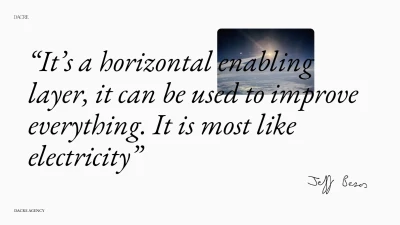
Speed is the most common answer. It allows us to get to the lowest-hanging fruit as quickly as possible. Removing the barriers to entry considerably. From market research and ideation through to design and production.
15 insights in 1.5 seconds. 2000 assets in 2.9 seconds.
Centered around efficiencies, volume, and scalability. For brands, this is enticing. How do we do more with less and achieve the promised land of ‘faster, better, cheaper’.
GenAI will be the leading enabler here, fronted by the major tech platforms. Amazon is already working on over 1000 different AI projects at any given moment.
Write a few prompts and watch your marketing plan, lay down and KPIs be set and assigned for the year.
Upload your brand expression system and watch the production of your quarterly assets spat out.
Watch as your media spend is fully automated, optimised and insights unraveled all year round.
Lie back and bask in your ‘guaranteed’ returns. Fluctuating based on a click of a button, depending on the level of risk you’re willing to take.
AI will do all the grunt work. The stuff that is repeatable, time-consuming, and can be commoditised. The truth is, it’s already happening.
“Klarna has already cut its workforce from 5,000 to 3,800 in the past year, and wants to reduce that to 2,000 employees by using AI in marketing and customer service” BBC
“BT revealed in May that it plans to cut 55,000 jobs by 2030, more than 40% of its global workforce, with 10,000 being replaced by AI” Guardian
Our opportunity lies between the commoditised core and the blurry grey edges of the future.
Balancing a deep understanding of the core - how to use, manipulate, implement, and scale it. Helping businesses achieve higher growth at a lower cost.
With the moonshots, the out-of-the-box, the real tricky stuff. Crafting new ways of seeing, forging fresh perspectives and unearthing the unusual & unexpected.
It’s mixing our own critical thinking, creative ingenuity, and emotional intelligence… all our glorious messiness with the machine of efficiency, greater effectiveness, and the ability to do more with less.
It’s in this tension, this moment of change, that we will find new magic.
It’s how they’re going to punch above their weight. It’s how they’re going to unlock huge sustained growth.
It’s our new operational long and short of it.
Brands, like the performance trap, that solely focus on the core will be in the hamster wheel of the same same but different. Finding it harder and harder to squeeze growth out of the tired old lemon… a race to the bottom of diminishing returns.
The brands that balance the two with energy, optimism, and clear thinking will unlock a completely new place to play. One that is unexplored and full of possibilities.
It’s how we will mix the old with the new. The human and the machine. The real and the artificial.
It's why, to Jeff Bezos’s point, it’s one of the most exciting times to be alive.
02. Why creativity is in all of us and how to harness it
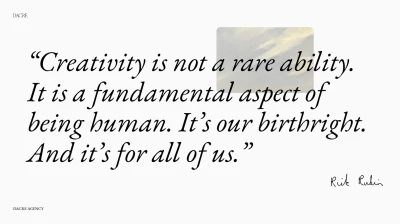
Advertising has always had an odd relationship with creativity.
It’s become our mecca. Our promised land. Something that is fiercely debated but fiercely misunderstood.
We’ve tried to package it up and sell it by the bottle. Using it as our one big differentiator. Clinging onto the golden era of big ideas and big egos.
What we’ve missed is that people don’t want ‘creativity’, they want what it enables.
Apple doesn’t sell creativity; it sells products that are desirable and valuable to society. They do this better than anyone else. This is the reason why they’re one of the biggest companies in the world.
So how should we think of creativity?
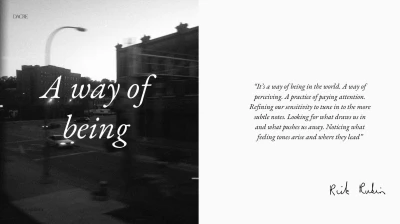
“Creativity is the artistry and imagination we need in order to achieve popularity and fame for the brands we advertise… if it’s to mean anything useful, it is the art and skill of winning and keeping that audience”. Paul Feldwick states in his book ‘Why does the Pedlar sing?’.
Creativity is the fuel to our fire. It should run through everything we do. But it isn’t our end product. Businesses start stalling when they cling to the idea of creativity vs actually creating something that has value in the world.
Our value lies in finding and creating what people find valuable. Offering a solution to a problem. These are the fundamentals of good business.
It’s not about big ideas or blue sky thinking. Ideas are simply starting points; the hard part is how we give them life in the real world. How do we turn them into something beautiful, interesting, and entertaining?
This act, this process, and this path are what true creativity is.
This doesn’t come from one team or department. Businesses and people are much more fluid and complex than that. They come from everyone and everywhere, all working towards one shared vision. It’s about pointing it in the right direction.
It’s about having an organisation that is centered around the act of creation. As businesses grow, as people get promoted, they move further away from creating.
As bureaucracy grows, creativity diminishes. It’s why large businesses get disrupted by small start ups.
So it’s time we went back to the act of creating. Focusing on building true value. It’s going back to what makes us human.
03. Why is everything just a bit dull?
“From film to fashion and architecture to advertising, creative fields have become dominated and defined by convention and cliché. Distinctiveness has died. In every field we look at, we find that everything looks the same” Alex Murrell
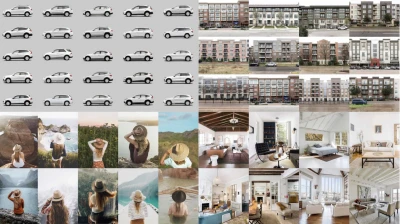
Interiors all look the same. Architecture looks the same. Cars look the same. Even our faces are starting to look the same.
Think of all the music that samples classic hits. All the movies that are remakes. All the fashion throwbacks. Nostalgia everywhere.
Forming the future by remixing the past. Led blindly by data of what ‘worked’. The act of creation turned into a formula, an algorithm and a set of numbers. In the process, crushing our confidence in our own abilities and ingenuity.
All of us look at the same things, drawing inspiration from the same.
You see it everywhere in advertising.
Simply remove the logo of a brand and replace it with that of its competitors. 9 times out of 10, it just advertises the category, not the why behind the brand.
GenAI will only accelerate this through the commoditisation of creativity. Ploughing more and more content into the world for us to consume. Slaves to the same. Slaves to the attention economy. Slaves to the algorithm.
It’s Warhol's wet dream. Everyone will be famous for 15 minutes. Then fade away. Mechanical reproductions. The printing press of modern-day life.
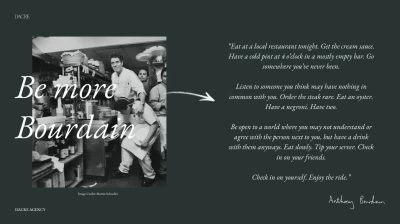
It’s understanding that success is found in unexpected thinking. It’s reconnecting with what makes us unique.
Our realness. Our faults. Our differences. Our diversity. Are becoming some of our biggest USPs. There is power in being mortal.
This is the same for brands. The brands that will define the next decades won’t be the ones looking down from up on high, churning out the same same but different. Focusing on volume over substance. Speed over effectiveness.
The brands that are real. The brands that listen. The brands that are amongst us, meandering through the streets, gutters, and complexity of our everyday messy lives. These are the ones that will win.
Let’s not be solely led by Silicon Valley's warped view of the world. Let’s plant our own trees.
04. Will AI do 95% of our job?
If this is the case in our industry, what is our role? What is our worth? Where is our value?
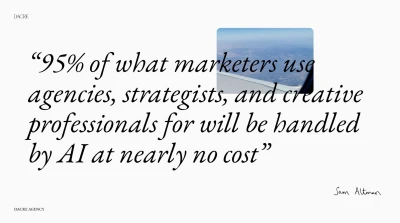
AI will do some of it but Sam Altman’s dream and the tech industries in general come from a fundamental misunderstanding of how advertising works. It’s also part of the reason why we still have so many ineffective ads. It’s why the skip button exists.
It’s because advertising isn’t rational.
Rory Sutherland eloquently sums this up in an article he penned for Campaign about why the business and tech world doesn’t accept the role of psychological factors in advertising effectiveness.
“It is not that businesses do not know that advertising creativity works. No, deep down in their hearts, people in business know perfectly well that advertising creativity works. It’s simply that they do not feel comfortable with the fact that it does. It messes with the map of the world they hold in their heads. They would rather pretend that their success is attributable to efficiencies, economies of scale, cost-cutting or any MBA guff than to think that it might be due to psychological factors.”
We’re in the business of people. And, ultimately, selling things.
People are unpredictable, irrational, and generally messy. Just look at all our lives.
We can forecast to a level the impact of our marketing efforts but it’s unlikely we will be able to ever truly predict exactly what will happen.
The belief is that from strategy through to execution, you can productise each element, brand it up, and ship it off, all for the lowest cost at the highest volume. This isn’t what will create effective advertising over the next decade.
The thing it misses is that our industry isn’t just one thing. It’s an industry that meanders through the cracks, gaps, and grey matter of art, business, and science to anthropology, psychology, and philosophy.
It’s about openness. It’s about the ability to have our eyes wide open to the world. It’s weaving and working personality traits, egos, and opinions.
It’s about forging the future we want. One that will produce the largest and most sustainable growth for the brands we serve, the people we work with, and ultimately, the best for the customer.
05. If AI does all the work, how will the next generation of talent thrive?
“How can we scale this business and eliminate the human capital line item?”
This is the unspoken reality of the types of conversation boards and investors are having or will have over the next 3 years.
Management will be asked and it’s being seen in RFI’s “AI thick staffing plan versus a human thick staffing plan, and what are my cost savings?”
As the barrier to creating becomes more and more commoditised. How will people build a career in the industry?
If the high-level thinking is already done. The hardcore strategy. The day-to-day work that we’ve all learned, failed, tested, succeeded, elevated our careers through doing.
If that is all done by AI, how will the next generation of talent thrive?
Our challenge is how we create the right environment for talent to progress through the ranks in a space where they can test, learn, and try stuff out all whilst being paid fairly, in good conditions that elevate their careers and positively progress our industry…
We owe it to them. We owe it to the future of the marketing/advertising industry to protect, help nurture, and form it together. It’s on all of us.
06. What does this all mean?
- AI and creativity are enablers: they’re horizontal enabling layers. They’re the fuel to our fire. It’s how we harness them to craft new ways of seeing, forge fresh perspectives, and unearth the unusual and unexpected.
- Human led, tech enabled: it’s mixing our critical thinking, creative ingenuity, and emotional intelligence… all our glorious messiness with the machine of efficiency, greater effectiveness, and the ability to do more with less.
- Create what people want: This is how wealth is created. For brands and people. If you’re creating something people want, people will reward you. This should be the north star for all decision-making.
- Inspire through empathy: As technology advances, it will fundamentally change how we create and have a direct impact on the world of work. As leaders, how we navigate this, put people first and help them thrive, continue to learn, and adapt to this moment of change is key. It is on all of us.
What we do at DACRE
DACRE guides brands through moments of change. We revive forgotten companies and scale new ones by building brands that people want to buy from.
We deliver change across three services.
We deliver change across three services. Positioning brands in what customers value, creating distinctive identities & campaigns that enrich.
Enjoyed reading this?
You can read more of our thinking on our blog and in our brand reports.