
The future CMO and what it means for marketing
05 Feb 2026
We interviewed top marketers from the likes of the BBC and VodafoneThree to Formula E and RSPB to create an in-depth look at the future of marketing.
We asked three questions:
01. What are the biggest challenges marketers face?
02. What are the most undervalued opportunities for marketers?
03. What will continue to be important and stay the same?
This long-read is built around the three questions, each chapter exploring a different theme. From the value paradox marketers face through to how leaders can create the right environment for their teams and partners to thrive in.
What we cover
- Why marketers are living in a value paradox
- Why the biggest challenge isn’t reach, it’s indifference
- How the pace of change is moving us away from consumers
- Why in the age of eligibility, your brand might not get seen
- Why knowing the fundamentals is our biggest differentiator
- The need for more rigour upfront and the three axioms of strategy
- Why we all need a little more patience and kindness
01. What are the biggest challenges marketers face?
The Struggle for Proof:
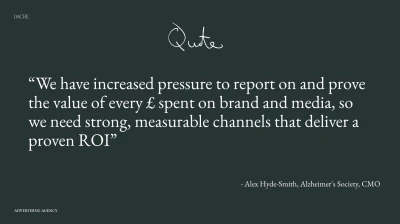
Organisations face increased pressure to report on and prove the value of every pound spent on marketing.
Value is one of those things that has many layers. Value, at its core, is providing something someone wants.
The challenge marketers face today is delivering value in a world full of contradictions.
The tension between what is best for consumers and what will please the business. These two important things don’t always marry up. This is the value paradox of marketing.
In a market where uncertainty is the default, marketers' budgets, every pound of it, is being scrutinised.
As businesses across the land scramble each quarter towards their targets, value is measured in what it delivers in the short-term. Who bought, at what price and how much revenue did it drive?
The tech giants know this. With near precision, they can tell the value that was created with the money put in.
This is our industry's addiction. One we wear proudly around our neck. Hooked on the information the platforms provide, turning an information bias into an industry culture, all neatly organised by the platforms that serve our impressions.
The problem with this is that marketing, in the words of Rory Sutherland, is a “fat-tailed” business.
The “thin-tailed” model expects gradual returns that are easily measurable. Conversion rates, customer acquisition costs and click-through rates.
The “fat-tailed” are the outliers. The small percentage of your marketing generates disproportionately huge results, “10% of efforts yield 130% of value” as Rory says.
- A PR article sells as much product as you have in 2 years.
- A campaign makes national news and increases awareness by 50%.
- A social post goes viral and reaches more people than you would have in 5 years.
We can’t predict or easily measure these things. The way our industry attributes value isn’t set up for it. These outliers have long-term effects for months, years and sometimes decades.
Yet you won’t see these effects in your dashboards and studies; they will naturally show up elsewhere, likely attributed to other parts of the business.
So how do marketers navigate this?
“Perform vs Transform" Tightrope:
How do marketers balance delivering results today whilst investing in the right places to create long-term value tomorrow?
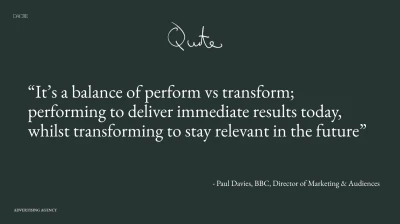
It’s the hamster wheel of Les Binet and Peter Field, “The Long and Short of it”.
Marketers, businesses and shareholders need results today. This will always be the case. Short-term results aren’t bad. They help keep the business flush with cash and grease the wheels of an efficient, growing business.
The trouble with focusing mainly on short-term effects is that it leads us up the garden path. Obsessing over a cheaper cost per click whilst neglecting future buyers who are not yet in the market.
“The challenge is protecting long-term brand value while staying commercially competitive in the here and now” - Chris Doe, Marketing Director, Pilgrim’s Europe
We should also have our eyes wide open to the platforms we serve. Scrutinising the information and measurement as an industry we rely on. Looking under the murky water of the numbers and understanding where our impressions get served.
It’s reported that fraudulent ads account for 10% of Meta’s advertising revenue, which is approximately 16 billion dollars. Globally, it’s reported that every $1 in $5 goes to non-human traffic. With projections of losses to advertisers of nearly $172 billion by 2028.
In an era where trust is becoming everything, where we’re seen and who we crop up next to, will have a large effect on the trust our consumers place in our brands.
The Confidence Gap:
The cost of living crisis, rising employment costs and geopolitics are eroding an organisation’s confidence in investing in long-term success.
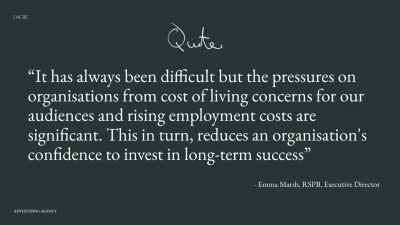
A large factor of what drives short-termism is what worries people in a business and the people those businesses advertise to.
Affordability with a capital A is a sticky issue.
Consumers are full of contradictions here. We all want to have our cake and eat it. Just ask governments. Grappling with trying to keep voters happy whilst growing the economy today and investing in the infrastructure of tomorrow.
“Low prices when they shop, high wages for themselves; not many immigrants but lots of cheap labour; rising house prices when they own and lower ones when their children want to buy” The Economist
Businesses have been hit on every front. It costs more to employ people. Rising wages. A lagging market. A fractious world. With the largest technological advance we’ve ever seen. With the constant drumbeat of hungry shareholders and consumers still expecting the very best.
The world is shifting and it’s shaping the landscape we are marketing within. Whilst what we read in the news sometimes feels like it lives in a different room to the one we inhabit at work.
The world around us, what happens and how it affects people, has huge macro and micro effects on what people buy and where they spend their time. As obvious as it sounds, this is very often overlooked in upfront planning and strategy.
If we’re serious about understanding consumers, then we must have a broad understanding of the state of things that are fueling their feelings and actions, paired with deep knowledge of the category in which we’re operating.
One thing is sure: the future will provide massive changes in our lives. How brands can help educate, entertain and enrich during these changes will determine their role in the markets of tomorrow.
Here are some key things that are going to shape the landscape we’re marketing within:
The old global rules-based world is drifting: We live in a world dominated by America and China, both countries combined accounting for nearly half of global GDP. The global economy has fundamentally changed and that will continue to change how consumers shop.
Europe’s problems: Without America propping it up, the EU faces real challenges. It must increase defence spending, boost economic growth and keep America on side… whilst maintaining free trade. The hard choices the EU has to make over the coming years are going to shape the next few decades for businesses and people that live and work across it.
Economic pressures: The global economy has been more resistant than people thought. Though it’s dampened many countries' growth, many are still living beyond their means with no real policy to help claw it back. Even though wages have risen, to consumers, everyday prices from food to clothes feel like they keep going up-and-up.
Inflated AI: For AI to create the imagined future the tech bros are promising, it needs an incomprehensible amount of two things: capital and energy. And the tech world is taking big bets on both. The successes and failures of those bets will shape how we work, how we live and how we spend our time.
Mixed climate: The world is still getting warmer. The pledged target of limiting warming to 1.5 °C now seems highly unlikely. Though global emissions have likely peaked and clean tech is booming. Consumers can see through pretend purpose and greenwashing. Doing good is now the default and if your brand isn’t going far beyond the average, consumers will start thinking twice.
Weight loss wonders: Better, cheaper GLP-1 weight-loss drugs are coming in pill form, with access expanding rapidly. It will fundamentally change how we eat, what we want to eat and when. How will brands react and cater to our new metabolisms? What role will food now play in our lives?
Consumer Apathy:
One of the biggest challenges brands face isn’t the lack of reach but indifference.
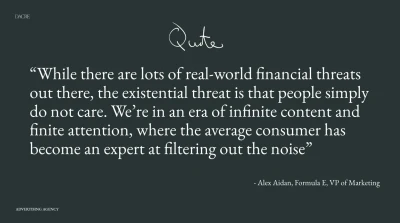
Indifference to your products, brand and communication. Brands worry about large-scale mishaps that destroy their business overnight. This is rarely the case. Brands die slowly and quietly, edging further and further into the corner, fading away without any trace of existence.
This comes down to one thing: total apathy to the single most important thing, the consumer.
For many businesses, marketing is seen as an investment, simply a cost of doing business. One that demands an immediate payback. One that constantly seeks to make that cost line more efficient and leaner as everyone continues to tighten their belts.
To procure marketing the same way as how a business would procure the ingredients that make up its products fundamentally misjudges how marketing works.
Marketing is predominantly what we argued in ‘The Value Paradox’, “fat-tailed”. Focusing on just making the marketing engine more and more efficient is a means to an end. An average sausage-making factory. The “no one got fired for buying IBM” approach to decision-making and risk management.
The trouble is this type of decision-making only has one thing in mind, the business, not the mind of the end consumer.
Why startups historically can outperform and steal large chunks of market share from right under the noses of much larger incumbents is because they’re typically born out of a large, glaringly obvious consumer problem and stay closer to it for longer.
- Amazon made buying seamless
- Uber made travelling simpler
- Monzo made banking transparent
Each year, marketing feels like it gets more complicated. We push the consumer to the side and lock in on tactics, hacks and thought leadership.
Trying to figure out how to optimise our way through the platforms and algorithms that govern who gets to see what. The platforms are constantly changing to keep us in a panicked spiral of figuring out what actually works.
Digital Fortress:
Over the past decade, platforms have begged, borrowed, and stolen people's time, data, and privacy. People are fed up; we’ve created our own digital fortresses to protect ourselves.
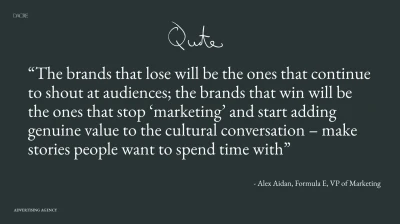
Trust in big tech is at an all-time low; we simply don’t believe them and this is only going to get tougher with the rise of AI.
When brands are surrounded by millions of mini fortresses, how are brands going to gain trust? As Warren Buffett, the legendary investor, says:“If you had to own only one car for your lifetime, how would you treat it? You would look after that car like your life depended on it”.
Now flip this to marketing: “If the brand you work for is the only brand you would ever work for, over a 40+ year career, how would you go about approaching it?”
This is a lovely reframing. It does the one crucial role of marketing, put the consumer right at the top of everything. It starts to shift everything in a business…
- Look after consumers like your life depended on it.
- Invest in your team, their training and career path.
- Protect and nurture your brand and its distinctive assets.
- Think in years/decades, not just months/quarters.
This is empathy. This is an organisation that puts people and consumers first. Marketers are one of the functions closest to the consumer; we should be the champion of them always.

Pace of Change:
Time feels like it’s accelerating. Fueled by more tech, more channels and more content. Making marketers feel like they’re constantly one step behind.
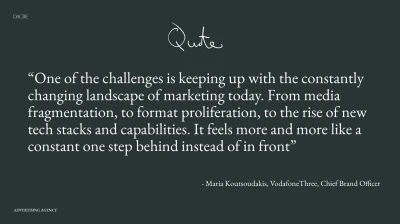
We’re in a world of information overload. Driven by a 24/7 news cycle, social media and now the rise of AI.
Our brains are frantically trying to figure out what to pay attention to and what to ignore. Juiced up by stimuli after stimuli from the streets we walk to the glare of screens.
“More information has been produced since the 1970s than in the last 5,000 years combined” - Jungwirth & Bruce
This is especially true of the marketing industry. An industry obsessed with shiny new things.
Each year is fueled by the endless drumbeat of trend reports and new tactics, tying ourselves in knots on what to focus on and what to ignore.
Resulting in the default of doing a lot of things, normally not very well, driven by the fear of missing out and appeasing the pressure pot of internal politics and conflicting business objectives.
What marketers are dealing with is a fog of focus. Fueled by tech, more channels and content proliferation. The constant feeling of being one step behind.
Lost in the fog, marketers run the risk of distancing themselves from how consumers actually act, their behaviour and ultimately their desires. We switched traits and biases for tools and tactics.
“AI accelerates everything: content, testing, iteration, and response times can be near-instant. The risk is fragmentation. Brands that move fast without coherence will disappear from consideration, even if they are prolific” - Susan O’Brien, Yellow Days, Fractional CMO
Hidden cost of efficiency:
We’ve been sold the dream of ‘faster, better, cheaper’ by the platforms and adtech. Constantly being sold new ways to ‘speak’ to consumers, the challenge now isn’t on what to do; it is on what not to do.
The problem is, with these foggy efficiencies, they come with hidden costs. Under the cloak of “do more with less”. Less budget, fewer resources and more channels. All with different formats, ‘best practices’ and apparently different ways consumers behave.
We now can create 70,000 assets a year at a very small cost. On paper, this is marketing’s mecca. But it comes at an unseen cost. In the quality of what is being created and the resulting management of those assets. You can create as many assets as you like but if consumers don’t notice them, connect them to your brand, then there is little point.
We’re stuck in the fog of that more is better. No brand needs tens of thousands of assets a year. What we need to focus on is less, that is better and that is kept in the market for longer.
By doing more and creating more, it needs more management to keep it afloat. What marketing departments and agencies forget is that a human still needs to control, check and sign off assets.
This creates a snowball effect of more layers of bureaucracy, full of middle managers who spend their time on quality control rather than understanding the consumer better. The money you save upfront, you end up wasting on ignored impressions and bloated teams.
The other issue brands face is one of control. Control over how the brand shows up consistently and distinctively. As brands have more and more consumer touchpoints, this is becoming harder and harder.
Each channel is controlled by a range of different teams across organisations and with conflicting goals. Ploughing time into platforms that brands don’t own but simply rent. Governed by the laws and algorithms housed in the black box of big tech.
What this means is that brands need to reconnect themselves with what matters. Not just what is being sold to them as marketing's next big thing.
The Era of Eligibility:
We’re entering a new era of eligibility. From lashings of ‘free’ organic reach, to a sponsored ad model and now an even more closed system that decides if a brand gets seen or not.
In every strategy doc, there will be one slide announcing the fragmentation of media. This is true… to an extent. We have more channels and platforms than ever and varying levels of attention spread across them.
But if we look at the growth of ad spend globally, it’s highly concentrated. The likes of Google, Meta and Amazon account for more than half the market. Eight out of the ten biggest sellers of ads are tech firms.
We’ve gone from fragmentation back to concentration. And as every platform spits out more and more AI features from buying and measurement to automation and creation, tech’s grip is only getting tighter.
What is emerging is an even more closed system of what gets seen and what doesn’t. As platforms have moved from the early 2010s of lashings of ‘free’ organic reach to a muted and highly weighted ‘sponsored’ model, is now turning into one around eligibility.
- Can an LLM pick up, read and digest your brand easily?
- Does it trust your brand enough to recommend it as an answer?
- Does it provide the right and most compelling answer?
What this means for marketers is that the worry isn’t now just reach and visibility online, created over years and years of SEO, PR and social posts.
The challenge now is, will you get picked up at all? This is discoverability on steroids. You’re not only communicating in the best way for humans but for our new artificial language.
What is different from the rise of search engines is that LLMs and agents are becoming a primary interface for people and brands to meet. It’s not just a listing of URLs matching a handful of keywords; LLMs are understanding the intent and moment in time for consumers.
As the rise of personalised agents becomes more of a reality, the room for brands to muscle themselves in will only get harder… and likely more expensive.
The shoes you wear, the cot you bought, the jumper you’ve got and the books you read will influence the buggy it suggests. We’re moving from the world of the ‘best buggy’ to the ‘best buggy for me’. And if your brand doesn’t explicitly demonstrate and articulate the value you bring… then you’re not going to be seen.
02. What are the most undervalued opportunities for marketers?
Master the Fundamentals:
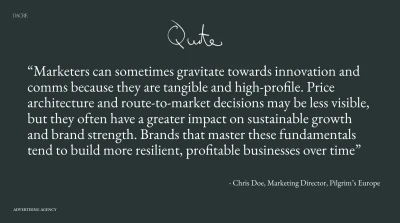
Growth often lies in ‘unsexy’ areas of marketing like price architecture and route-to-market decisions rather than just communications and the new.
As the marketing professor Mark Ritson points out, “pricing is the aspect of marketing that delivers profit more than any other”. The thing is, you won’t hear the word ‘pricing’ muttered much across marketing departments and agency offices. Marketing has consciously or unconsciously moved away from one of the big Ps.
Now it’s highly unlikely you will be able to strut in and start setting the price for all your products or services. Where there is huge untapped value for marketers, though, is what Ritson calls “perceived value” of pricing. As the voice of the consumer, Marketers play a very important role in how that all-important price is framed and anchored.
“Imagine a sentence where the font is more important than what the sentence says. Take that into pricing. In all my travels, it is incredibly apparent that the way we present, communicate, change, frame the price is more important than the price itself” Ritson says.
It explains why we always go for the second-cheapest bottle of wine. We don’t want to be ripped off, though not look cheap but get something we actually enjoy.

It explains why we think precise numbers are more honest. When a builder comes round to do a quote and says flippantly that everything is £1,000, we don’t trust it. But if they say £1,232.92, we’re likely to trust it more.
It explains why we think expensive things signal that they’re better. It’s why luxury brands rarely discount; we use price as a proxy for quality, even though the £290 white t-shirt gets made in the same factory as the £5.99 one.
Now, product is extremely important and if you talk to the vest-wearing tech bros, the only important thing. What is equally important, though, is how product, price, place and promotion are framed. Framing is marketing's job.
Framing is about stacking one unfair advantage on top of another. It’s what the famed investor Charlie Munger once coined the “Lollapalooza Effect”. And framing starts with what consumers actually want. You can call it fancy things like market orientation but it’s really about creating value in the eye of the beholder.
“Every act you have performed since the day you were born was performed because you wanted something” Dale Carnegie
People are driven by their wants and desires. People buy products and pay for services because it fulfills those desires. Does it help their health? Sleep better? Show off their wealth? Make them feel important? Feed them? Indulge them? Simply make life easier for them?
The question is where does your product fits within people's desires and how you frame it to maximise and communicate that value.
- L’Oreal > ‘Because You’re Worth It’ > Self-worth
- Apple > ‘Think Different’ > Status
- Disney > ‘The Happiest Place on Earth’ > Escapism
We obsess over the latest algorithm change, newest placement and latest TikTok trend but understanding what drives people to do the things they do and how marketing influences that, is one of the most undervalued and misunderstood things.
In the words of Munger, “If you don't get this elementary, but mildly unnatural, psychology of misjudgment into your repertoire... you will go through life like a one-legged man in an ass-kicking contest".
Rigour, our Old Friend:
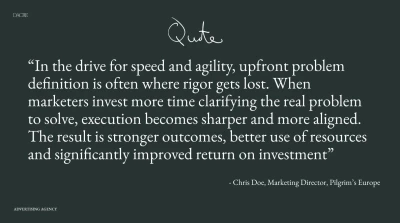
In a world driven by immediate ROI, investing more time in problem definition before execution leads to sharper outcomes and improved long-term ROI.
In a world driven by quarters, immediate ROI and ‘spray and hope’ goal setting, brand strategy becomes an “oh if only we had time”.
What usually takes its place is a frankensteined deck of strategy upon strategy cooked up last minute, briefed into all agencies, sent back with conflicting and grand-sounding objectives, all done in crazy formatting.
Presented to management, ticked off, then lay to rest in the depths of some untitled folder somewhere… reverting back to the same tactics of last year that may have or may not have worked.
Unfortunately, this is the reality we all see too often. Rigour is being underinvested in and tactics are overinvested in.
When it comes to strategy, brand strategy is the strategy marketers should be focusing on. It makes little sense to have a creative, social, and AI strategy that all sit separately. The brand strategy then feeds and informs the tactical choices, with the right briefs to address them.
The most straightforward and effective approach is what Mark Ritson calls the “three axioms”.
Axiom 1: Diagnosis
This is where you take a step back. Where is your brand tracking? Check if your segmentation needs revising; meet consumers, interview them, get out there and see how your brand is perceived in the real world. Look at what didn’t and did work last year. Go round the organisation, fact-finding, cross-referencing and understanding pain points. Combine it altogether to create a robust and honest lay of the land, even if it hurts to hear.
Axiom 2: Strategy
As the acclaimed professor Michael Porter puts it, “the essence of strategy is choosing what not to do.” This is the simplest and most clear definition of what strategy is about. Too many brands try to do too much. The ‘spray and hope’ approach. Living in the false sense of security that if you do everything, no one can point out that you haven’t done anything. Pick three to five things you’re going to do, tied to measurable outcomes and the investment to do so.
Axiom 3: Tactics
Tactics are crucial but not before the upfront rigour of the first two.
Tactics are the things that are going to help you achieve your goals. What way do you need to cut the budget to do this? What is the team, partners and tools that you need? Having a neat strategy is all well and good but if it doesn’t get executed against, it is wasted.
Every brief, in-house and to partners, should be the vehicle to organise everyone towards achieving the goals. Allowing you to protect them through the rigour that went into them. Making the batting away from conflicting distractions and the joys of appeasing internal politics, that tiny bit easier.
Patience vs restlessness:
Brands take time to develop and embed. The problem is marketing teams get restless quicker than brand assets and campaigns take time to wear in.
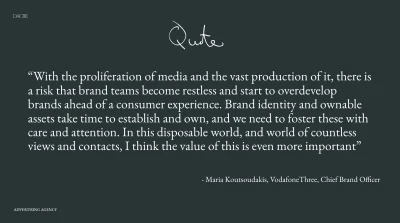
Brands play a very small role in people's lives. In marketing, though, it feels like the most important because it’s our job. It’s what we spend our week worrying about. The trap we fall into is how we theorise and talk about brands in the safety of our offices vs how brands are experienced in the real world.
To shift your perspective for a second, try this litmus test:
Think of the things you use every day. It could be the granola you eat for breakfast, the surface cleaner you use or the soap you use to wash your hands.
Think of them and now…name the brand, their logo, product name, colour, shape and size of packaging and what the price is.
You probably got more wrong than you thought you would. This is the stuff you buy weekly or monthly. And even after that, we still struggle to remember.
Now for the advanced level, try it with a toddler shouting in your ear, whilst driving with the radio on full blast. This is the reality of how people interact with brands, on autopilot, usually doing a hundred and one things i.e. life!
If the litmus test is correct, years of picking up, buying, advertising and whatever else still doesn’t 100% make us know the name and price of that brand's product, then constantly changing, updating and generally messing around with the brand makes little sense.
We get much more restless and bored with our own marketing than consumers do. Now, some updating and newness signal a brand's strength and prowess. And a re-articulation of a brand through a campaign nudges people's memories along. But the fundamentals shouldn’t change much of your brand.
When we hear the word consistency, everyone nods along and understands its value. Yet we’re terrible at sticking to it. As humans, we naturally gravitate towards newness and instant gratification than the long-term and delayed gratification.
This is also fueled by the systems we work in. Promotions, pay rises, quarterly results. Running similar advertising for years feels counterintuitive to this… but with much of life, it isn’t necessarily the case.
In the System1 study, Compound Creativity, it analysed brands across a range of channels at their creative consistency, looking at 4,000+ ads from 56 brands across 44 categories and spanning 5 years.
What they found is that brands that are consistent turn out better ads, strengthen their brand and create a larger business impact. These are what we call the three C’s: Creativity, consistency and compounding.
The challenge for marketers is balancing these three over the short and long-term when you have a CFO breathing down your neck.
How this balance works is through pointed positioning, with a few concise, simple messages repeated and a suite of consistent, distinctive brand assets… brought to life in novel ways. Whether it’s performance or brand, both live in the same mind of the consumer.
A marketer's role is to help the brand they’re entrusted with live as long as possible. Many brands we work on will outlive us. Our role is to pass them on in better shape than we found them.
C 1 - Creativity:
Realistically, whether in-house or agency side, the people who work on brands over the course of their career are going to have 1-5 truly great ideas. Ones that create a disappropriate amount of value to that brand. Half of the challenge is knowing a great idea when you see one and carefully bringing it into the world.
C 2 - Consistency:
When you get a hit, so many brands move on, lay it to rest and go off to try and find a new one. The best thing to do is double down on that idea. Build on it, open its doors and expand the world it lives in. Continuing to improve it, keeping it relevant and making it bigger and better… whilst maintaining its essence.
C 3 - Compounding:
As Albert Einstein famously said, "Compound interest is the eighth wonder of the world”. Brands should be asking themselves, what are the decisions today that will create large chain reactions tomorrow?
03. What will continue to be important and stay the same?
The Human Connection:
Good marketing requires two things: stories that grab people and emotion that moves people… whether they save it for later or buy it right then.
With the act of creating, over millions of years, we’ve grown from the only power being the energy our bodies and minds can muster, to tools forged from iron and steel, to now totally artificial ones. We’ve gone from being the master of the tools, to them being an extension and soon the tool itself not needing us.
In a marketing context, big tech has two imagined futures for our industry:
The first is total commoditisation:
“AI will do 95% of what marketers use agencies, strategists, and creative professionals for today” Sam Altman.
The second is complete control over distribution:
"We're going to get to a point where you're a business, you come to us, you tell us what your objective is, you connect to your bank account, you don't need any creative, you don't need any targeting demographic, you don't need any measurement, except to be able to read the results that we spit out. I think that's going to be huge, I think it is a redefinition of the category of advertising." Mark Zuckerberg
Even if a small part of this comes true, it will fuel an even greater homogenisation of marketing and the advertising people see. As the allure of cheap and fast will suck many brands and agencies in.
What will be the result? Consumers will continue to put up even greater barriers to keep the slop at bay and their privacy intact.
From an industry based on understanding what consumers want, we will run the risk of moving ourselves even further away.
The biggest risk is being average, fading into the endless stream of content served. Cold, shouty and inauthentic. What will never change is humans' craving for connection, our craving for rich stories, ones that understand us, teach us, make us laugh, cry and even buy. But they make us feel something.
They’re crafted with care, every last detail thought about. A respect for ourselves and a respect for the person we’re communicating with.
“Technology may decide which brands are shown, but it cannot decide which brands people believe in. That belief is built through ideas, experiences, and behaviour, not prompts or platforms.” - Susan O’Brien, Yellow Days, Fractional CMO
Whether we use AI, photoshop or a paintbrush, it doesn’t matter. It’s how we use our communications as a vehicle to educate, entertain and enrich the lives of our audience. This won’t ever change.

Psychological Drivers:
The human need for status, belonging, safety and emotional connection will remain the immutable drivers of behaviour.
Why do we do the things we do?
This is probably the most important question marketers should be asking themselves. What drives consumers' behaviour?
At the core of a marketer's role is to understand the consumer, the person who pays everyone's salary and why that company exists. It’s the thing that greases the whole organisation.
The better we understand what drives consumers, the greater value for the consumer and in turn, for the business. Allowing us to make better products, provide a better service and craft more relevant communications.
We’re all consumers and we’re driven by hundreds of behavioural biases, helping us make decisions every day, developed over millions of years, whether we’re consciously aware of them or not.
Richard Shotton and Rory Sutherland are leaders in this field of marketing. Below are ten biases and tendencies that all marketers should understand…
1. Social Proof: We copy what others are doing, especially in uncertainty. It's why word of mouth, testimonials and product reviews are so potent.
2. Framing Effect: Our decisions are influenced by the way information is presented. £90 a month sounds expensive, £3 a day sounds reasonable.
3. Authority Bias: We’re more influenced by the opinions of authority figures. It’s why advertisers have always used celebrities and now influencers.
4. Primacy Effect: We tend to remember the first piece of information we encounter better than anything later. It’s why the best advertising has one clear message, repeated.
5. Mere Exposure Effect: Our tendency to develop preferences for things simply because we are familiar with them. It’s why advertising exists: to make people aware and familiar.
6. Loss Aversion: The emotional impact of a loss is felt more intensely than the joy of an equivalent gain. If your offering feels like too big a risk, consumers will go elsewhere.
7. Incentive Bias: We’re more motivated to act if it’s attached to a reward. Competitions, exclusive offers and loyalty programs keep people motivated to keep coming back.
8. Reciprocity Tendency: When we feel compelled to return favours. It’s why free samples, great customer service and generous portions make us like a brand more and spend more.
9. Availability-Misweighing Tendency: When we overweight information that’s vivid or recent. It’s why brands that are distinctive get remembered and that you’ve last seen.
10. Scarcity Bias: How limited availability increases perceived value. It’s why brands like Supreme built a business around limited edition drops and why people are happy queuing for restaurants.
Great Leadership:
Is about creating the right conditions for teams to thrive in. Through clarity of goals, rewarding bravery, showing respect and acting with kindness.
The role of senior marketers is to lead, guide and create an environment for a group of people to thrive in, whether they work in-house or are a partner. An opportunity for talent to do the best work of their careers.
We need great leadership more than ever needed before. The ability to provide clarity, take calculated risks and inspire the people around us. This can be hard. When you face internal politics, the pressure to deliver instant results and constant justifications of any long-term investments.
In a world that can sometimes feel tough and unforgiving, we need to understand the people with whom we work day in and day out, as much as we try to understand our customers.
From mergers to AI, people are worried they will lose their livelihood, grads are facing fierce competition to get on the job ladder and salaries aren’t going as far as they used to.
All of these things leadership teams need to acknowledge. Work isn’t therapy but people spend a large chunk of their lives there and we should have understanding, empathy and kindness in these moments of change.
What we do at DACRE
DACRE guides brands through moments of change. We revive forgotten companies and scale new ones by building brands that people want to buy from.
We deliver change across three services.
We deliver change across three services. Positioning brands in what customers value, creating distinctive identities & campaigns that enrich.
Enjoyed reading this?
You can read more of our thinking on our blog and in our brand reports.