
What does brand look like in 2030?
05 Mar 2026
What will 2030 look like? The honest answer is that no one really knows.
Whilst the trend chasers, vibe shifters and transformation ‘experts’ are confidently predicting the future.
At DACRE, we’re taking a different approach. Asking the question, what won’t change?
As Jeff Bezos points out, what won’t change is something you can build a solid strategy around.
For a business like Amazon, customers now and in 5 years’ time will still want faster delivery and lower prices. This is what their whole business and brand are built around.
Change is about how businesses compete. Knowing what to keep the same and what to do differently. What to add and what to remove.
The ones that manage change well will be the ones we’re still talking about, buying from and are profitable.
What we cover
- For brands less is now more important than 'more'
- When everything changes, the motives still remain the same
- Brands have new means but they still achieve old ends
- Brands have the same problems, just different days
- Why brands need to keep it simple, stupid
- Why a brands reptuation is becoming increasingly difficult to manage
01. For brands less is now more important than 'more'
“I very frequently get the question: ‘What’s going to change in the next 10 years?’.... I almost never get the question: ‘What’s not going to change in the next 10 years?’ And I submit to you that that second question is actually the more important of the two” - Jeff Bezos
Change is how businesses compete.
We’ve just defaulted to using words like transformation and innovation to describe it.
Obsessed with what is going to change vs spending time on what will stay the same.
Hooked on adding more and more vs taking the non-essential away.
“While everyone else adds mass to the system, removing it creates an unfair advantage. The lighter you are, the faster you move. Removing what shouldn’t exist creates more value than any addition could” - Shane Parrish
We live in a time where more is more. Because more is becoming easier, cheaper and faster to create.
As more loses its value and meaning. The art of finding focus and knowing what to take away is where value will reside.
02. When everything changes, the motives still remain the same
“Means and instrumentalities change; motives and ends remain the same” - The Lessons of History by Will & Ariel Durant
Value is made by creating something people want. It’s a two-way street.
We’ve relied heavily on seeing value through the eyes of product and price alone.
From the tradition of the 4 P’s of marketing: Product, Price, Place and Promotion.
What we miss is the context it sits within, people. And most importantly, what motivates them.
Things that are important to most people
- Health and the preservation of life
- Food
- Sleep
- Money and the things money can buy
- Feeling of importance
- Sex
- Afterlife
- Well-being of children
In every strategy, brief and project… these are the underlying tones that are at play.
They might be dressed up as ‘sell more, launch this and gain more awareness of that. But everything goes back to the exchange of value and providing something that people want.
“Every act you have performed since the day you were born was performed because you wanted something” - Dale Carnegie
03. Brands have new means but they still achieve old ends
“All technological advances will have to be written off as merely new means of achieving old ends” The Lessons of History by Will & Ariel Durant
Creating an ‘asset’ a century ago would have taken a team of people, paint, brushes and a large amount of time. Now you need one person, an internet connection and an LLM…. what would have taken weeks, now takes seconds.
But there is no such thing as a free lunch and efficiencies come at a price.
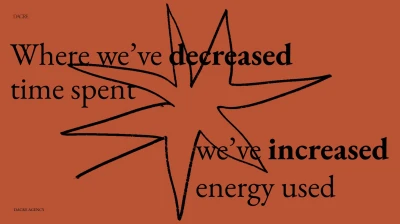
Where we’ve decreased time spent, we’ve increased energy used.
The industrial revolution fundamentally changed our world and is the bedrock of many things we take for granted today. Yet at the same time, it has contributed to the sustained destruction of the world we inhabit.
AI will transform our world, likely in many cases for the better. But the question to ask is, what are the trade-offs of the new means?
- Does it actually make things better?
- What are the problems it creates elsewhere?
- Are the trade-offs worth it?
These are the questions brands should be stress testing their decision-making against over the next 5-years. Maximising the potential upsides whilst protecting downsides. Not just for their business but the ripple effect it has on the people and world around it.
This isn’t about purpose. It’s more about values.
Something that guides, focuses and drives it forward. The non-negotiables. It helps choose the right objectives to achieve the long-term goal.
As the ad man Bill Bernbach once said,“A value isn’t a value unless it costs you something”.
Think of Carmy’s non-negotiables in The Bear. Scribbling them down in the pursuit of a star.
From ‘shirts perfectly pressed’ to ‘less is more’. It’s the stuff that informs everything.
Businesses have been told by the brand police they need a lofty ‘change the world’ or ‘progress civilisation’. In reality, not every brand needs this.
Because in the end, the right values take on a deeper purpose that emerges over time by doing the hard things well. Creating a reputation, culture, products and attracting and retaining the right talent.
We get obsessed with new means or tools but really, we should be looking higher up at values. This then informs the tools chosen.
So when you’re next ‘mandated’ to integrate [insert new tool here] into everything you do. Ask why? Does it make things better? Does it ladder up to the values? At what expense? Are the trade-offs worth it? Is there a different, more effective way?
04. Brands have the same problems, just different days
There are six things every brand will still be grappling with in 2030:
- Too many focus areas
- Constant shifting priorities
- With a lack of resources to fulfill them
- Driven by short-term decision-making
- Made difficult by a siloed mentality
- With a lack of budget to make real progress
The bigger the business, the bigger these problems play out and become harder to solve.
The symptoms of these problems turn up on the doorstep of every brief, project, collaboration and relationship.
From 5 messages squeezed into one ad, designed by a committee, to campaigns being pulled last minute, or not enough production or media budget to bring it to life and make a dent.
What these stop is a business achieving its full potential. You can see it in the share price, the office floors and Zoom calls.
The role of marketing and advertising is to create an outcome. It’s never just been ‘colouring in’, as much as we’ve lived up to it. We make businesses more money.
Through new ways of thinking, fresh perspectives and the unexpected. Whether those are ways to get work made or the work itself, they’re two sides of the same coin.
When the agency JWT received a brief from a milling business, “how to make more money from the flour they milled”.
They didn’t reply with a 30” script. They created the cake brand, Mr. Kipling. That is still a market leader 50 years on.
As the industry becomes more and more commoditised, moving upstream has never been more important.
So when you next hear the industry is dead, it’s not; it’s just everyone has been fishing on the wrong part of the river for too long.
05. Why brands need to keep it simple, stupid
Advertising feels like it gets more and more complicated every year.
Hooked on newness. Seduced by the complex. Peddled by the trend chasers, vibe shifters and transformation experts.
Mystified by jargon, pseudoscience and the pretentious.
As an ex-agency CEO said recently, “the digital transformation experts have been transforming for the last decade”.
The best brands in the world weren’t built by constantly chasing newness and shifting priorities.
They were built on understanding what people want, doing the hard things well and doing it over a sustained period of time. Guided by a set of core values.
“A large part of the art of advertising is telling the same story, over and over, but in new and entertaining ways” - How Brands Grow, Byron Sharp
So much of good business and advertising is counterintuitive. It’s the famous BBH strapline “When the world zigs, zag”.
It’s why the most rebellious acts are found in the simple and obvious.
“Simple can be harder than complex: You have to work hard to get your thinking clean to make it simple. But it’s worth it in the end because once you get there, you can move mountains” - Steve Jobs
This is the reason why DACRE exists. It’s our point of view that dictates all our decisions, work and partnerships.
Brand is a circle around an entire business. It’s your moat.
A moat that lives in the minds of your customers and those that are not.
Existing through a network of signs and signals to form some sort of memory and perception of that brand in its entirety.
One that is ever changing, shifting, sloshing around in the subconscious, driving decisions without any of us knowing much about it.
Warren Buffett, the investment kingpin, is the forefather of brand moats. It’s what his whole investment strategy is built around.
Coca-Cola, Apple, American Express, Kraft Heinz.
Making him one of the world’s richest men and Berkshire Hathaway, his investment company, in the top 5 of the Fortune 500.
Increasing…
Loyalty: Your customers are less likely to buy from your competitors
Pricing power: You’re able to raise your prices without a significant loss of customers
“The single most important decision in evaluating a business is pricing power. If you’ve got the power to raise prices without losing business to a competitor, you’ve got a very good business. And if you have to have a prayer session before raising the price by 10%, then you’ve got a terrible business.” Warren Buffett
Future demand: people buy from you when times are good and when times are tough
Differentiation: hard to erode your market position because you’re tough to copy
It’s why it’s the largest competitive edge a business has.
So when people say they don’t believe in brand. Just tell them Warren Buffett sent you…
06. Why a brands reptuation is becoming increasingly difficult to manage
Building a brand is one thing, but protecting it and maintaining it is another.
Reputation is key, but new challenges are making it harder and harder to manage. This is because of the rise of AI bot networks that are being set up to disrupt brands across the globe.
“What’s different now is how quickly AI-powered bots can spin up ‘grassroots-looking’ campaigns around incendiary or divisive issues, e.g., culture-war topics, and keep them trending” WSJ article
Look at the contentious rebrand of Cracker Barrel: “Bots authored 44.5% of X/Twitter posts mentioning Cracker Barrel in 24 hours”. At one point, there were 400 Cracker Barrel posts a minute about the boycott.
The President of the United States, Donald Trump, even weighed in, commenting on his platform, Truth Social, about changing it back.
Hours later, they changed it back.
“The online logo backlash began with human-run accounts that have hundreds of thousands of followers… Hundreds of bots soon began sharing the posts, replying to them and posting their own… Seventy percent of the accounts promoting boycotts at that point used duplicate messages, a key marker of coordinated bots” WSJ article
This isn’t a one-off; this is happening to more and more brands globally.
In a world where what is true and what isn’t is becoming even more blurred. It’s never been easier for someone to create and distribute information at lightning speed. How you monitor, react and proactively maintain that flow of information is key.
It’s beyond social listening. It’s breaking silos down to bring leadership closer to marketing, PR, customer service and product. It’s changing the role of crisis management from a what-if to when. It’s setting up task forces that are rooted in marketing.
The role of a CMO hasn’t become easier, as Martin Sorrell believes, it’s become harder, larger and even more of an important factor in setting up businesses for success over the next 5 years.
What we do at DACRE
DACRE guides brands through moments of change. We revive forgotten companies and scale new ones by building brands that people want to buy from.
Enjoyed reading this?
You can read more of our thinking on our blog and in our brand reports.